

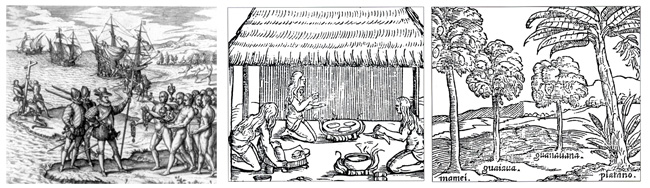
The Taínos, whose name literally translates to good people, were the seafaring people indigenous to the Bahamas, Greater Antilles, and the northern Lesser Antilles. At the time of Columbus's exploration, the Taíno may have numbered one or two million throughout the Caribbean, making them the most numerous indigenous people of the region. The Taínos were considered one of the Arawak peoples of South America, and their language was a member of the Arawakan family of language in the northern areas of South America. When Christopher Columbus arrived to the New World in 1492, he became one of the first (and only) outsiders to witness the Taíno culture. Recent ancient DNA research has confirmed that the ancestors of the Taíno originated in northern South America, validating earlier archaeological theories.
At that time, the Taínos had five chiefdoms and territories spanning the Hispaniola (the Dominican Republic and Haiti of today). Some scholars estimate the Taíno population may have reached more than three million on Hispaniola alone as the 15th century drew to a close, with the largest population centers containing over 3,000 people each. Each of these chiefdoms were headed by a principal chief referred to as the Cacique, who could be male or female. It was to this chief that tribute was paid. The name given by the Taínos to the island of Hispaniola was Ayiti (meaning land of high mountains) is still very much in use today.
It is the Haitian Creole form of the name Haiti used by its people till today. The Hispaniola was not the only center of the Taíno civilization. In Cuba, the Taínos had over 29 chiefdoms, creating a complex network of political organization across the Caribbean islands.
Cuba itself is a name derived from the Taíno language, however its meaning is not today known. Some Taíno land which later became Spanish colonial cities retained their Taíno name and those names are still in use today for example; Havana, Camagüey, Batabanó, Bayamo and Baracoa. Modern Puerto Rico was also home to the Taínos. Records indicate that at the time of the Spanish conquest, there were large Taíno centers with population of 3,000 people each, demonstrating sophisticated urban planning and social organization that rivaled European settlements of the era.
Interest in and study of the Taínos didn't gain much ground until the early 20th century. For a while, mainstream scholars did not consider the Taínos as a separate group of indigenous people. However, through their unique pottery (white painted on red), scholars were able to trace the origins of the Taíno people. There are two different schools of thought on the origin of the Taíno, though recent genetic studies have provided new evidence supporting certain theories.
According to one school, the ancestors of the Taíno people migrated from near the center of the Amazon Basin and share relations with the Yanomama. The scholars who belong to this school of thought site linguistic, ceramic and cultural evidences to back up their argument. Recent ancient DNA analysis has provided strong evidence supporting the northern South American origin theory, confirming that Taíno ancestors migrated from present-day Venezuela and the surrounding regions. The other theory was originated by a scholar named Julian H. Steward.
According to Steward, the forbears of the Taíno people spread out from the Colombian Andes. This theory, which is referred to as the circum-Caribbean theory, suggests that there was a migration from the Andes to the West Indies as well as a parallel migration which took some of the people in Central America as well as into the Amazon Basin in South America. However, modern genetic research has provided less support for this Andean origin theory compared to the northern South American lowlands hypothesis.

One thing scholars do agree on is that Taíno culture, the way it is documented, developed in the West Indies. This is backed up by the creation story of the Taíno people. The story has the earliest Taínos emerging from sacred caves high on a mountain located in modern day Hispaniola. Archaeological and genetic evidence suggests the Taíno had a comparatively large effective population size, indicating a successful adaptation to Caribbean island life over many generations.
The Taíno society met by the Spaniards had two strata or classes the nobles (nitaínos) and the commoners (naborias). All the Taíno whether noble or commoner were subject to the rule of the chiefs, referred to as the caciques. Caciques could be of any gender and the position was a hereditary post. This egalitarian approach to leadership by gender was notably progressive compared to many contemporary European societies of the 15th century.
However the Caciques were advised by the healers/priest (bohiques). Instead of living in round bohíos like the rest of the villages, the chief got to live in square ones. They also got to wear golden (copper alloy) pendants (guanín), which symbolized their office. The bohiques were highly respected in the society, for their abilities to heal and their powers to speak with the gods. They were consulted before any important endeavor and granted the Taíno permission for their activities. These spiritual leaders maintained extensive knowledge of medicinal plants and astronomical observations, serving as both healthcare providers and religious authorities.
The Taíno were one of the few groups that practiced a matrilineal system of kinship, descent and inheritance. If there was no male heir to succeed, then the succession or inheritance goes to the oldest child (regardless of gender) of the deceased's sister. This matrilineal system was crucial for maintaining social stability and ensuring that leadership remained within established family lines, while also providing women with significant influence in political matters.
The Taíno also practiced avunculocal post-marital residence. Newly married couples were expected to live in the home of the bride's uncle. He would be more important in the upbringing and lives of any children born of the union than the biological father. Some of the Taíno also practices polygamy. Men and women would sometimes have two or more spouses. A few caciques had as many as 30 spouses, which served both diplomatic and economic functions by creating alliances between different communities and consolidating political power.

Both men and women were greatly skilled in agriculture. Although the men would fish and hunt, it was the agricultural skills of the women that people depended on. The primary root crop was yuca or cassava, a woody shrub cultivated for its edible and starchy tuberous root, which was planted using a coa, a kind of hoe made completely from wood. Women were responsible for processing the poisonous variety of cassava by squeezing it to extract its toxic juices, a sophisticated technique that required considerable expertise. The Taíno used a specialized form of cultivation called montones - semi-permanent mounds that were three feet high and nine feet in diameter with flat tops, which provided excellent drainage and loose soil for root crops. In addition to cassava, the Taíno grew squash, beans, peppers, peanuts, and pineapples, while tobacco, calabashes, and cotton were grown around the houses. The Taíno had no written language, though it is widely believed that they etched petroglyphs, symbols that were carved in stone, which served as important cultural and religious markers throughout their territories.



The TainoAge Project website started well over a decade ago. Back in 2007 I began to upload rock-carving/symbol findings to this site.