

Spirals represent one of humanity's most enduring and universal symbols, with archaeological evidence revealing their presence across diverse ancient civilizations spanning thousands of years. Petroglyphs featuring spiral motifs have been discovered dating back to the Neolithic period, with some examples from the Mesolithic era showing evidence of changing societal structures and spiritual beliefs. The remarkable consistency of spiral symbolism across geographically isolated cultures suggests a deep-rooted human connection to this fundamental geometric form.
The universality of spiral petroglyphs is truly extraordinary, appearing independently in locations as diverse as the Spanish region of Galicia, the British Isles, North America, and Polynesia. This widespread distribution occurred despite minimal or no direct communication between these ancient cultures, indicating that the spiral held profound meaning that transcended geographic and cultural boundaries.
The spiral's fundamental relationship with nature cannot be overstated. This archetypal pattern manifests throughout the natural world, from the microscopic DNA helix to the grand spiral arms of galaxies. On Earth, we observe spirals in the shells of mollusks, the arrangement of seeds in sunflowers, the formation of hurricanes and tornadoes, and the swirling patterns of ocean currents. This natural omnipresence likely contributed to the spiral's sacred significance across cultures.
Ancient civilizations recognized the spiral as a powerful symbol for creation, growth, and the eternal cycle of life. The spiral represents the unfurling of existence from a single point infinitely outward, symbolizing the steady control and movement of energy by humans, making it central to many spiritual and philosophical disciplines that continue to this day.
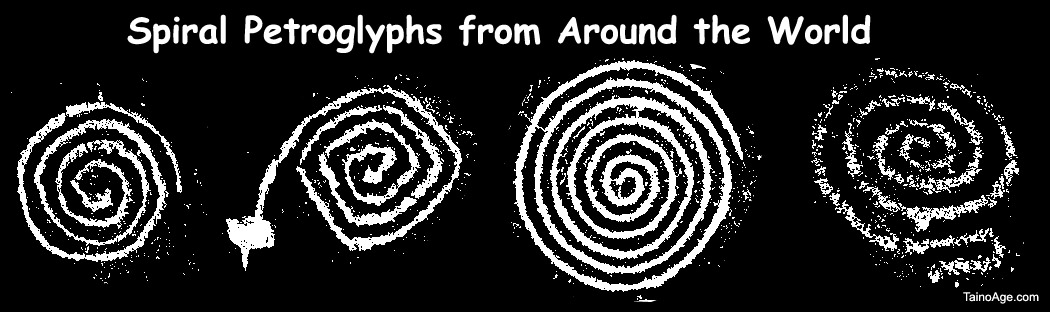
The Sun Dagger represents one of the most sophisticated examples of ancient astronomical engineering, created by the Chaco people approximately 1,000 years ago. This remarkable celestial calendar consists of three precisely positioned rock slabs leaning against the cliff face near the summit of Fajada Butte in New Mexico. Behind these carefully arranged slabs, the ancient Chaco people inscribed two intricate spiral petroglyphs that serve as the focal point of this ingenious timekeeping system.

The genius of the Sun Dagger lies in its precise astronomical alignments. The spiral patterns carved into the rock are thought to represent symbols for the sky or the sun among ancestral Pueblo peoples. As sunlight passes through the carefully calculated gaps between the rock slabs, it creates distinctive dagger-shaped patterns of light that interact with the carved spirals in meaningful ways. These luminous "sun daggers" align perfectly with the centers or edges of the spirals during the critical astronomical events of the year: the summer and winter solstices, as well as the spring and fall equinoxes.
This sophisticated understanding of astronomy demonstrates the advanced knowledge possessed by ancient American civilizations and their deep connection to celestial cycles. The Sun Dagger serves not only as a practical calendar but also as a testament to the spiritual significance these cultures placed on the movement of heavenly bodies and their relationship to earthly life.
Among the most celebrated and ancient spiral symbols in the world is the tri-spiral, or triskele, found at the magnificent Newgrange monument in Ireland. This exceptionally grand passage tomb was built during the Neolithic Period, around 3100 BC, making it older than Stonehenge and the Egyptian pyramids. The site's antiquity and sophistication challenge many assumptions about prehistoric European civilization.
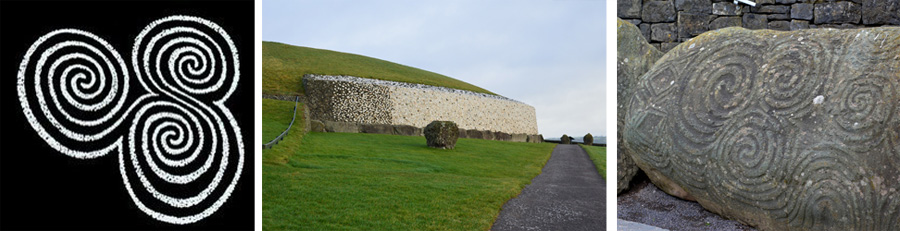
Newgrange stands as one of Europe's most remarkable prehistoric monuments—a massive circular mound containing an intricate inner stone passageway and chambers. Archaeological dating of objects recovered from the tomb places their creation between 2675 and 2485 BC, definitively establishing the site's age as predating the Egyptian Pyramids. The monument's sophisticated construction includes precise astronomical alignments that allow sunlight to penetrate the passage and illuminate the inner chamber only during the winter solstice.
The tri-spiral symbol, frequently misattributed to Celtic origins, actually predates the arrival of the Celts in Ireland by approximately 2,500 years, with its presence at Newgrange dating back to around 2500 BC. This chronological distinction is crucial for understanding the symbol's true origins and significance. The triskele is pre-Celtic in design, created before the Celts settled in Ireland, though it was later incorporated into Celtic cultural traditions.
The spiral motif dominates the megalithic art of Brú na Bóinne, with the triple spiral (triskele) found uniquely at this location. The monument contains multiple spiral carvings, including the famous triple-spiral emblem found both on the entrance kerb stone and inside the chamber on the side wall of the end recess.
The prevalence of spiral symbols in ancient burial sites across numerous cultures has led researchers to theorize that these symbols held deep spiritual significance. The spiral's endless, cyclical nature may have represented the concept of reincarnation and the immortality of the spirit, offering comfort and meaning to those contemplating the mysteries of life and death.
When Celtic culture emerged in Ireland around 500 BC, the ancient tri-spiral symbol experienced a renaissance, gaining new layers of meaning within Celtic spiritual and cultural traditions. In Celtic symbolism, the spiral transcended its earlier interpretations to represent the evolution, motion, and progress of human existence—encompassing both physical and spiritual development.
The Celts viewed the spiral as a symbol of temporal passage and celestial movement. Carvings throughout the chambers record lunar months as well as movements of the sun and planets, demonstrating the sophisticated astronomical knowledge of these ancient peoples. The spiral became integral to the creation of primitive calendars that were surprisingly accurate for their time, reflecting a deep understanding of cyclical time and natural rhythms.
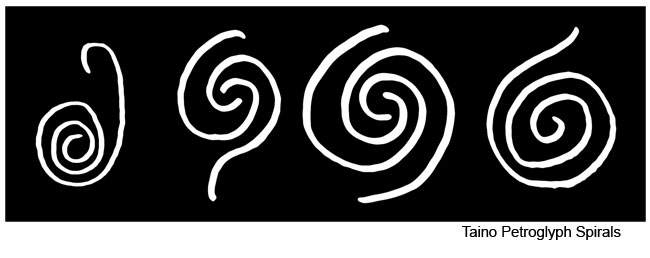
The spiral symbol's influence extended far beyond Europe and North America, finding expression in the rich cultural traditions of the Caribbean's indigenous Taíno people. In Taíno and pre-Taíno cultures, the spiral carried profound spiritual significance, representing cosmic energy and the sacred element of fresh water—both essential forces for life and spiritual well-being in Caribbean cosmology.

The Piedra Escrita (Written Stone) in Jayuya, Puerto Rico, stands as one of the most significant examples of pre-Columbian spiral petroglyphs in the Caribbean. These ancient carvings demonstrate the sophisticated symbolic language developed by indigenous Caribbean peoples and their connection to the broader global tradition of spiral symbolism.
The renowned Swiss psychiatrist Carl Jung, founder of analytical psychology, provided crucial insights into the universal appeal of spiral symbolism. According to Jung, the spiral functions as an archetypal symbol representing cosmic force—a fundamental pattern embedded in the human psyche that transcends cultural boundaries and historical periods.
Jung's analysis helps explain why the spiral appears so consistently across diverse cultures and time periods. As an archetypal symbol, it taps into deep-seated human understanding of natural patterns and spiritual concepts. The spiral serves as a sacred symbol representing the journey and transformation of life as it unfolds, following a labyrinth-like passage that leads toward spiritual Source or enlightenment.
The spiral's symbolic power lies in its ability to represent the consciousness of nature expanding from a central point outward, mimicking the fundamental patterns of growth and development observed throughout the natural world. This connection between spirals and natural cycles has linked them to the seasons, the path of life, and the eternal cycle of birth, growth, death, and rebirth that characterizes all existence.

On December 9, 2009, a mysterious spiral phenomenon appeared over the Norwegian sky, capturing global attention and sparking intense speculation about its origin and meaning. The extraordinary event began when observers noticed what appeared to be a brilliant blue light rising from behind a mountain, initially resembling a conventional atmospheric phenomenon.
However, within minutes, the light transformed into a massive spiral pattern that eventually covered the entire night sky above Norway and parts of Sweden. The spiral's perfect geometric form and enormous scale made it visible across vast distances, with thousands of witnesses capturing the phenomenon on video and in photographs.
Following the Norwegian incident, similar spiral phenomena have been reported in the skies over Sweden, Russia, and China, suggesting either a recurring natural phenomenon or technological explanation. While official sources attributed the Norwegian spiral to a malfunctioning Russian missile test, some details of the explanation have been questioned, including discrepancies regarding the reported launch location and the spiral's precise characteristics.
This modern spiral event has prompted some researchers to reconsider the traditional interpretation of ancient spiral petroglyphs. The suggestion that ancient peoples might have witnessed and recorded similar atmospheric or celestial phenomena adds a new dimension to our understanding of prehistoric rock art. If ancient civilizations did observe comparable spiral events in the sky, this would explain the urgent importance they placed on documenting these extraordinary occurrences in permanent stone carvings.
The thousands of spiral petroglyphs discovered worldwide may therefore represent not just abstract spiritual concepts, but also historical records of remarkable celestial events that left lasting impressions on ancient observers. This possibility bridges the gap between archaeological evidence and astronomical phenomena, suggesting that our ancestors were careful observers and recorders of the natural world's most spectacular displays.
Whether viewed as spiritual symbols, astronomical observations, or archetypal representations of natural forces, spirals continue to captivate human imagination and connect us to the profound mysteries that have fascinated humanity since prehistoric times. Their enduring presence in human culture testifies to the spiral's fundamental role in our understanding of existence, growth, and the eternal cycles that govern all life.


The possible explanations (on this page) of spiral petroglyphs found not just in Puerto Rico but globally, are purely speculative.

The TainoAge Project website started well over a decade ago. Back in 2007 I began to upload rock-carving/symbol findings to this site.